What company size is Compaas suited for?
Compaas primarily serves mid-market companies – typically from around 20 to several hundred employees. At this scale, regulatory requirements, customer demands, and limited internal capacity often collide without a dedicated compliance team being economically viable. Compaas scales the scope of support to your situation: from targeted advice on specific topics to holistic ISMS implementation. The approach avoids unnecessary overhead – measures are chosen to remain sustainable in day-to-day operations and are not planned beyond what the organisation can realistically support.
How long does ISO 27001 implementation take?
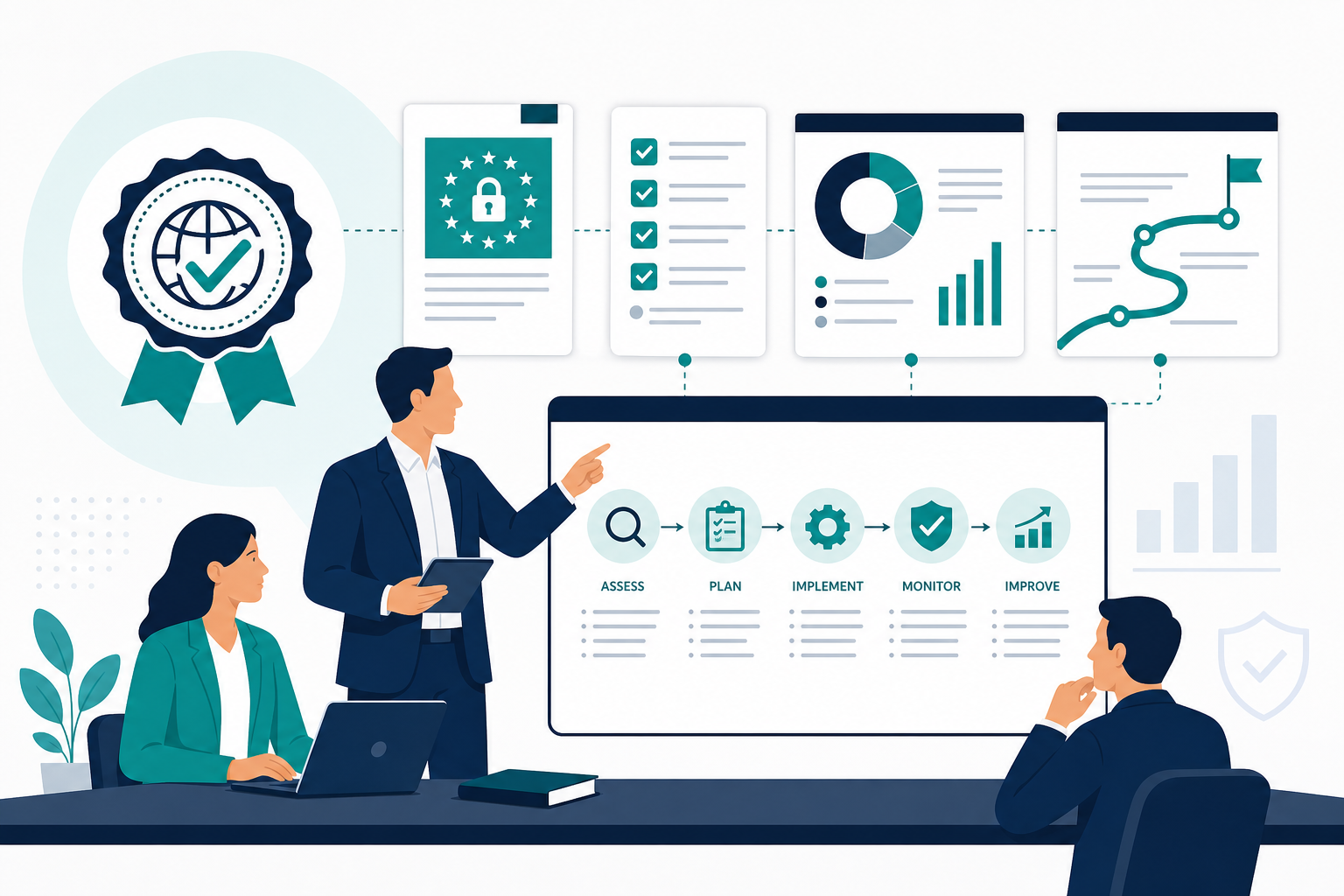
Duration depends heavily on your starting point: do you already have documented processes, a risk assessment, and baseline technical controls, or are you starting from scratch? After a structured gap analysis, Compaas creates a realistic implementation plan with milestones and effort estimates. In practice, the path to audit readiness is often a matter of months – not years, as is common with overloaded concepts. The key is consistent prioritisation: close the gaps that matter for certification, customer audits, or operational risk first. Compaas supports you through all phases – from gap analysis and implementation to certification audit preparation.
Do I need to implement all standards at once?
No – and that is usually not sensible either. Companies face pressure from multiple directions at once: ISO 27001, GDPR, whistleblower protection, CRA, defence requirements, or customer-specific supply chain demands. Compaas orders these requirements by urgency, risk, and dependencies and creates a roadmap with clear priorities. Where standards overlap – such as risk management, documentation, or training – Compaas exploits synergies instead of working in parallel silos. Step-by-step implementation relieves your organisation, keeps costs manageable, and delivers measurable progress faster than trying to tackle everything at once.
What distinguishes Compaas from large consultancies?
With Compaas, you work consistently with one dedicated point of contact – not rotating project teams or junior consultants. The founder combines experience in software development, compliance consulting, and ISO 27001 audit practice in a single person. That means solutions that are technically implementable, organisationally sustainable, and audit-ready in documentation. Instead of standard PowerPoints and generic frameworks, your organisation receives pragmatic measures tailored to your size, industry, and IT landscape. Compaas thinks along with you, prioritises honestly, and focuses where things actually move in operations.
How does an intro call with Compaas work?
The intro call is non-binding and serves as a mutual getting-to-know-you. Compaas gains an overview of your organisation, current situation, and which standards, customer requirements, or internal goals are in play. You receive an initial professional assessment – which topics are urgent, which can wait, and which approaches are realistic. By the end, you know whether and how Compaas can support you, and if needed receive a recommendation for next steps – such as a gap analysis or taking on a mandated officer role. There is no sales pressure; the goal is an honest assessment of whether collaboration makes sense for both sides.
What is a gap analysis and why do we start there?
A gap analysis compares your current state with the requirements of the relevant framework – for example ISO 27001, GDPR, or a customer-specific security catalogue. Compaas systematically reviews processes, documentation, technical measures, and organisational structures and identifies concrete gaps. The result is not a theoretical report but a prioritised action plan with effort estimates and a realistic timeline. This way you invest where the greatest need for action exists instead of approaching all requirements at once. The gap analysis forms the foundation for any further consulting and gives management a transparent basis for decisions.
Does Compaas also support customer audits and tenders?
Yes. Many mid-market companies face pressure because major customers, OEMs, or public sector clients impose their own security requirements – independent of formal certification. Compaas supports preparation for customer audits, completion of questionnaires (e.g. VDA ISA, TISAX-related requirements, or individual supplier assessments), and structured presentation of your compliance measures. For tenders, Compaas helps interpret security requirements professionally and demonstrate what is already implemented and what is still missing. The goal is for you to enter discussions and reviews with confidence – with documented evidence instead of hastily assembled paperwork.
What internal resources does my organisation need during implementation?
Compaas takes on the specialist heavy lifting but does not replace internal involvement. From your organisation we typically need a point of contact from management or a specialist department (IT, quality, HR) who can enable decisions and provide access to relevant information. Time commitment varies by project phase – intensive implementation phases may require more coordination in certain weeks, stable phases less. Compaas plans internal effort realistically from the start and structures workshops, reviews, and approvals to minimise disruption to core business. Transparent communication on progress and open items is a fixed part of the collaboration.
What happens after successful certification?
Certification is not an endpoint but the beginning of ongoing management system operation. On request, Compaas supports ISMS maintenance: internal audits, management reviews, risk assessment updates, and adaptation to new requirements. When your organisation evolves – new sites, systems, products, or regulatory obligations – Compaas accompanies the necessary adjustments. This keeps your management system audit-ready and prevents it from becoming a static document collection. Many customers use Compaas long-term as a dedicated partner for compliance topics – from annual surveillance audit preparation to step-by-step expansion to further standards.